 Hamroh IO
01System context#
The Mac communicates with hardware over USB. Nginx routes HTTPS traffic to the API, Admin and public website. The API uses PostgreSQL and private R2; the Desktop downloads firmware through an authorized, short-lived URL.

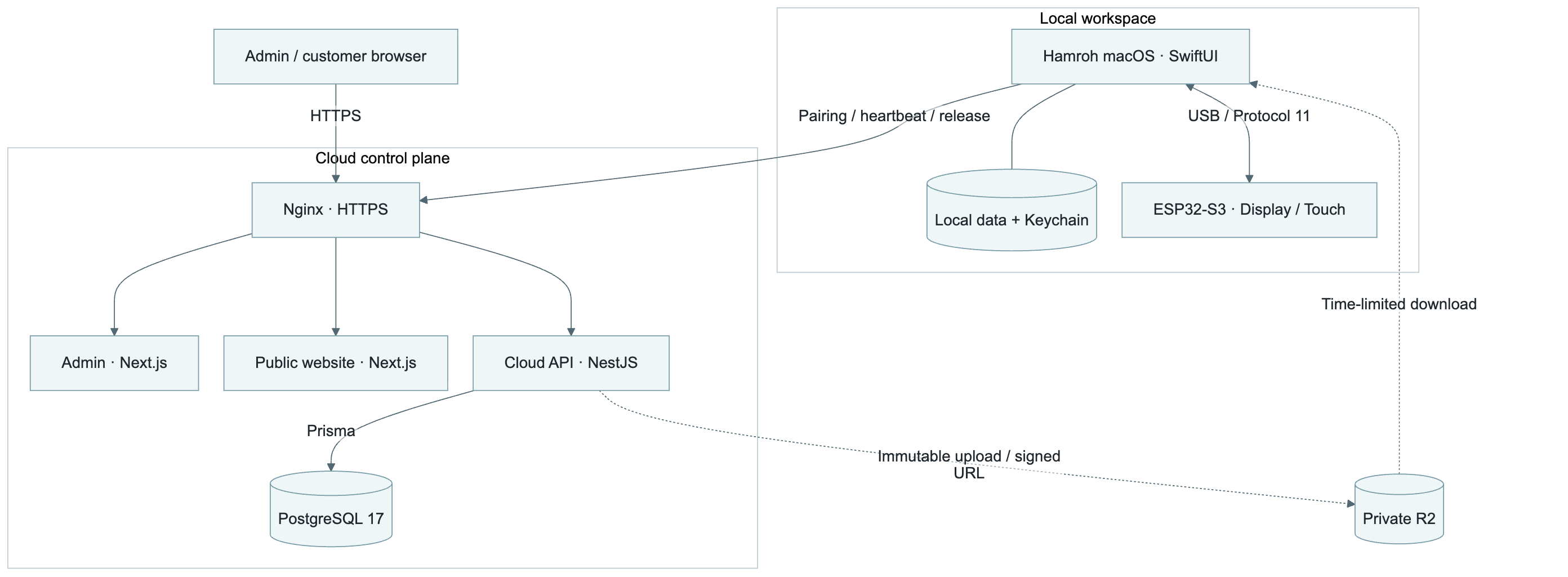
The API is not a fleet of microservices: authentication, devices, pairing, releases and business modules share one NestJS deployment. The current topology does not require Redis, a message broker or Kubernetes.
02Component responsibilities#
| Layer | Responsibility | Boundary |
|---|---|---|
| macOS | Tasks, focus, habits and notes; USB transport; firmware verification. | SwiftUI / AppKit. Local data and Keychain. |
| ESP32-S3 | Display, touch, animation, identity proof and OTA flash writes. | Flash-write authority stays on the device. |
| Cloud API | Pairing, inventory, ownership, firmware policy, heartbeat and audit. | DTO validation, authentication and role enforcement. |
| Admin | Operational management, release lifecycle, customers and orders. | Uses the API; receives no database credentials. |
| PostgreSQL | System of record for devices and cloud operations. | Prisma schema, constraints and transactions. |
| R2 | Verified immutable firmware and release artifacts. | Private bucket; temporary signed downloads. |
03Local-first data boundaries#
Tasks, habits and notes are stored by the native app’s local persistence layer. The current cloud API has no general synchronization contract for this personal content. This should not be interpreted as an existing multi-device cloud-sync feature.
- Internet is needed for pairing, cloud status checks and new firmware downloads.
- USB carries Desktop–device commands, identity proofs and normal OTA transport.
- Keychain stores the Mac installation private key and pairing credential.
- Local persistence is not a guarantee of application-level or full-disk encryption; host policy still matters.
04Trust boundaries & pairing#
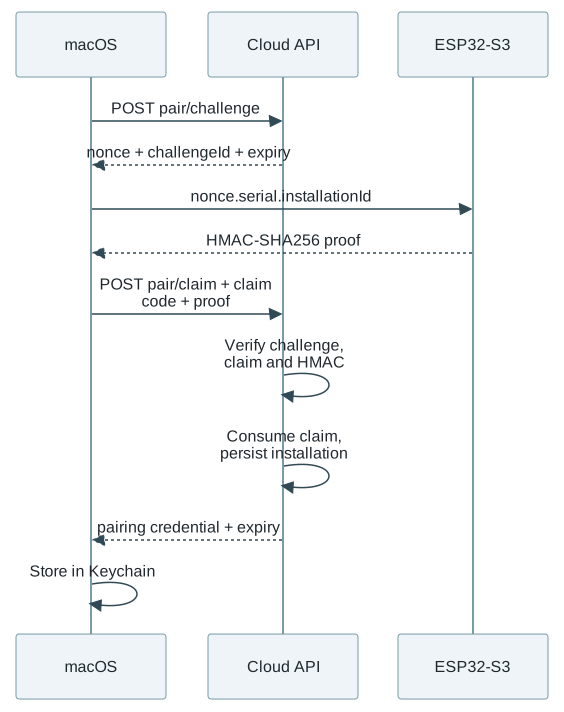
The server issues a five-minute challenge. The device computes an HMAC proof over the nonce, serial and installation ID. The API verifies the one-time claim code and proof, then issues a pairing credential.
| Material | Protection |
|---|---|
| Device secret | Held in the device identity namespace; encrypted with AES-256-GCM on the server. The normal runtime protocol does not export it. |
| Claim code | Stored as a peppered HMAC hash; marked consumed after pairing. |
| Admin session | Random token, hashed server-side; Secure / HttpOnly / SameSite Strict cookie. |
| Firmware signing key | Remains offline/local. The server, website and R2 never receive the private signing key. |
05Core data model#
Customers relate to devices through ownership records. A device may have multiple Mac installations. FirmwareInstallation belongs to a device–release pair and records the update outcome.

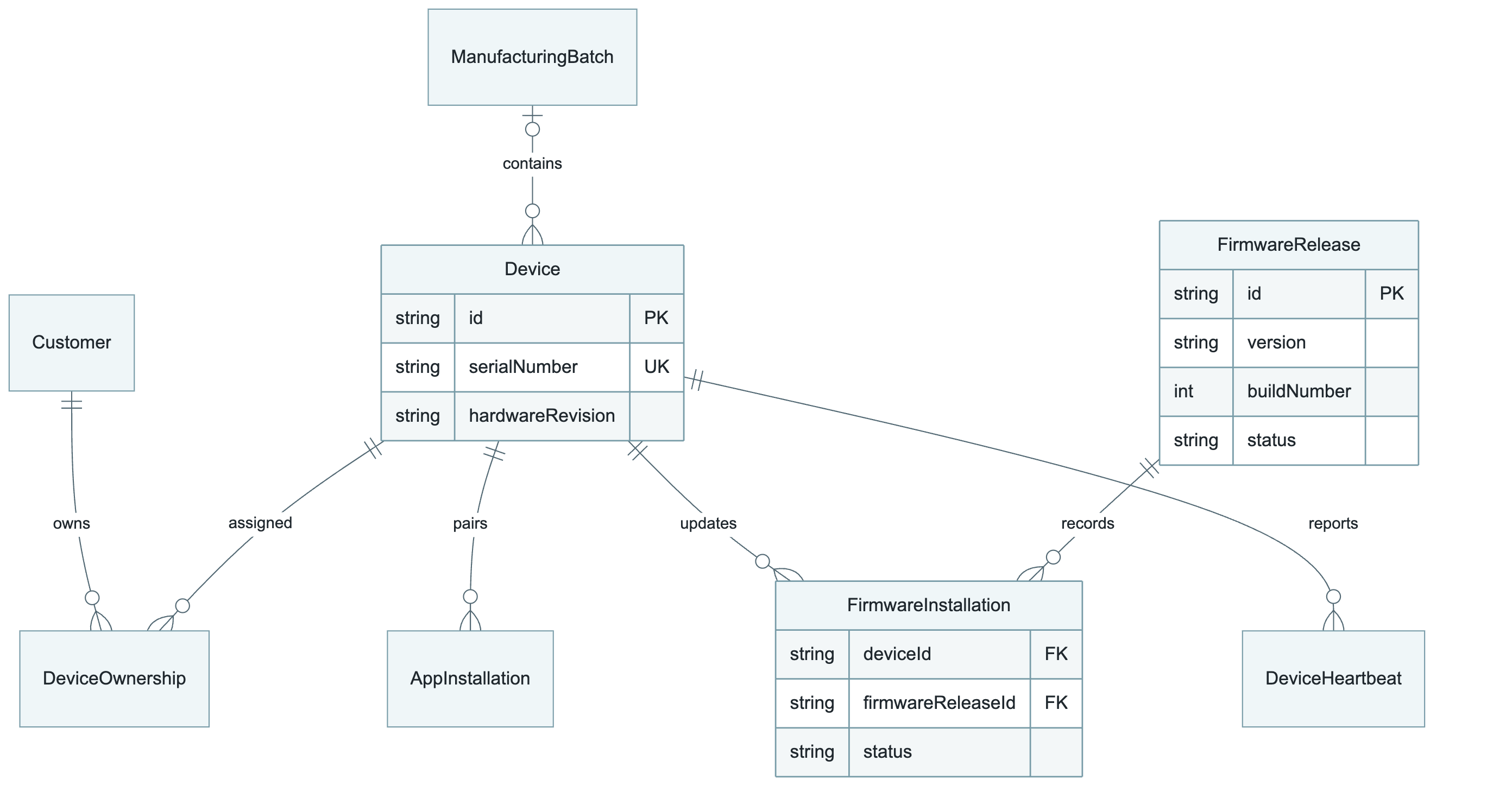
Unique constraints bound duplicates for serials, device–installation pairs and device–release pairs. Release identity combines version, build, hardware and channel. Heartbeats update the latest Device state while historical samples are retained at 15-minute intervals.
06Scaling & assurance boundaries#
The production inspection observed one host, Nginx and Docker Compose services. This provides a small operational footprint, but is not a guarantee of multi-zone high availability or autoscaling.
- Next scaling gate: API replicas, shared rate-limit state, managed/replicated database and tested restores.
- An independent penetration test, compliance certification, SLA or completed disaster-recovery drill is not asserted.
- Observed dependency-security findings require patching and regression verification.